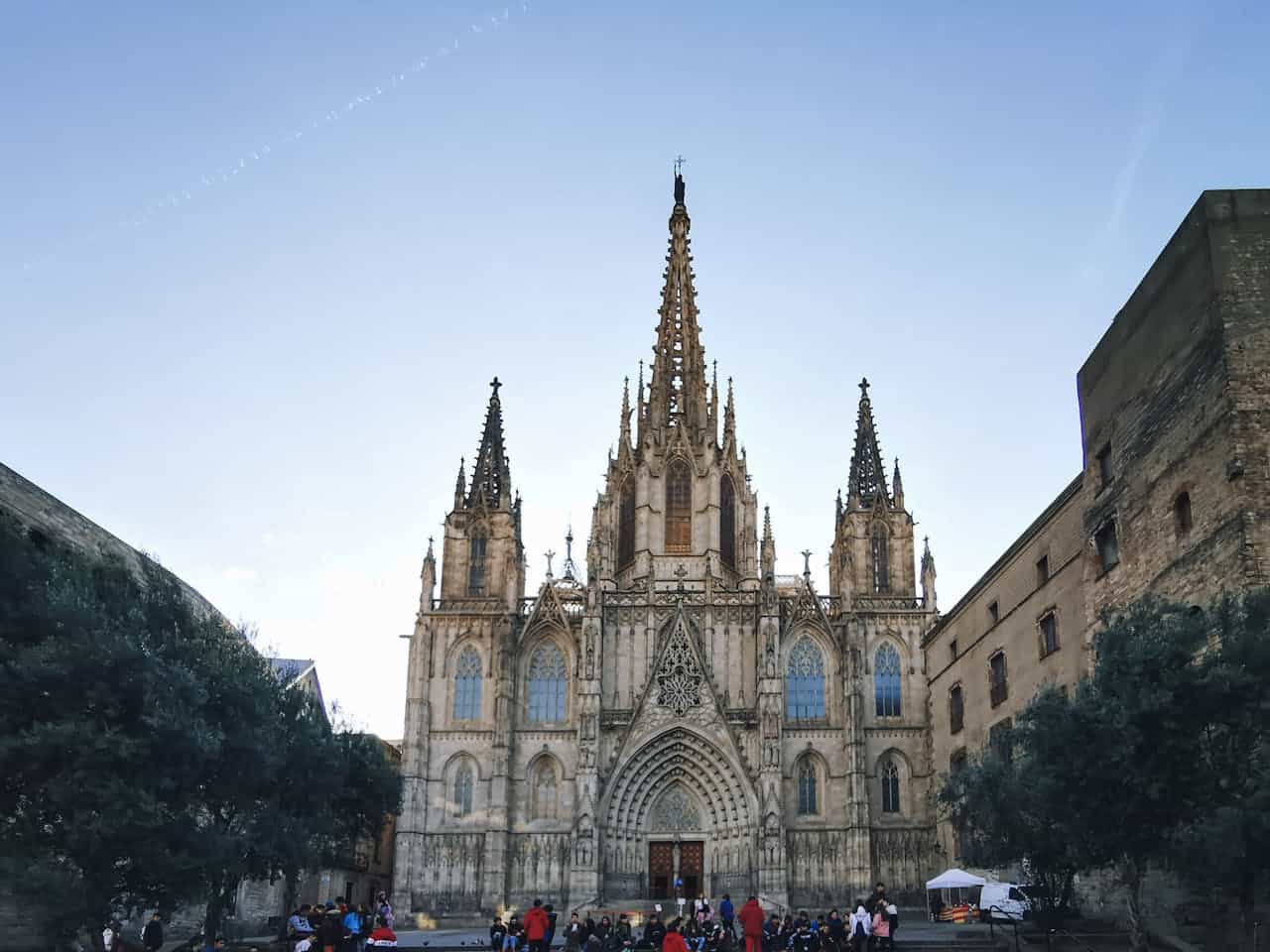
Although it’s a city crowded with tourists, it has a hidden side; in Barcelona, you can find real gems tucked away in its streets. There’s the postcard city, full of crowds and constant movement, and another, far quieter one that hides within the streets of its neighbourhoods. If you enjoy discovering authentic places, the challenge is not just finding them, but being able to move around easily to reach them. Walking through the narrow alleys of the Gothic Quarter can be quite a burden if you’re carrying luggage.
That’s why, before starting this route, it’s best to leave your bags in safe hands. Lock Here Now offers luggage storage at Sants Train Station and near Plaça Catalunya, so you can enjoy the city at your own pace.
Tamarita´s Gardens
Located in the upper part of the city, these gardens are the last remaining trace of the grand estates that once dominated the former municipality of Sant Gervasi de Cassoles. It’s a space inspired by romantic landscaping, where the noise of traffic completely disappears, replaced by the sound of fountains and the crunch of gravel underfoot.
Unlike other more crowded parks, Tamarita retains a sense of local exclusivity, untouched by tourist groups and large crowds. Its stone walls and centuries-old vegetation make it the perfect spot for anyone seeking a break from the everyday bustle.
Pasaje de Sert
Very close to the lockers, on Carrer de Trafalgar, this semi-private passage open to the public connects Trafalgar Street with Sant Pere Més Alt. Once the heart of a textile factory, it has now been transformed into a passageway filled with plants, design studios, and an overhead light that photographers find irresistible.
Just outside the passage, you’ll find El Bitxo, a culinary spot that won’t leave you indifferent. It’s a tiny, bohemian venue where creative tapas and wines are selected with exquisite taste. It’s the perfect place to savour a less commercial side of Barcelona after photographing the passage.
Arús Library
On Paseo de Sant Joan lies one of the most unique libraries on the continent. Founded in 1895, it stands out not only for its collections on anarchism and Freemasonry, but also for housing one of the few authentic scaled replicas of the Statue of Liberty.
This statue was installed to symbolise the values of the Enlightenment and free thought. Few Barcelonans realise that you don’t need to travel to New York to see “Lady Liberty”; you simply have to climb the solemn marble staircase of this library.
The Kiss of Death at Poblenou Cemetery
Far from being a gloomy place, Poblenou Cemetery is an open-air sculpture museum. Its most iconic piece, El petó de la mort (The Kiss of Death), is a marble work depicting a winged skeleton kissing the forehead of a young man.
After an introspective visit to the cemetery, you can head to the neighbouring district to try the mascarpone croissant at Hofmann Patisserie. Tucked away in El Born, this pastry shop is one of the locals’ best-kept secrets; its croissant has repeatedly been awarded the best in Spain.
Church of Santa Anna
It’s almost ironic that one of Barcelona’s most peaceful spots lies just a few metres from the heart of its busiest tourist area. The Church of Santa Anna features a 15th-century cloister where the temperature drops noticeably and the urban chaos fades away behind its columns.Located near Plaça de Catalunya. It offers a quiet, green refuge from the nearby, bustling Las Ramblas and often hosts intimate classical guitar concerts, providing a peaceful, historic stop in the city. If you’re in the area, do pop in – you’ll be surprised
Shelters of memory: Plaça del Diamant and Refugi 307
Barcelona was the first major city to be systematically bombed against its civilian population. Today, it is possible to descend into the air-raid shelters built by residents themselves.
- Plaça del Diamant: A labyrinth 12 metres underground in Gràcia.
- Refugi 307: Located in Poble-sec, it has more than 200 metres of tunnels.
If you visit Refugi 307 in Poble-sec, a stop at Quimet & Quimet is a must. It’s a legendary, tiny wine bar with no seating, where some of the city’s best montaditos made with preserved delicacies are served. An authentic spot where time seems to have stood still among floor-to-ceiling bottles of wine.
The best panoramic view of Barcelona from Torre Baró Castle
Refurbished in 2024, the Torre Baró viewpoint offers one of the finest panoramic views over Barcelona and the Collserola mountain range. It was originally conceived as a hotel project in the early 20th century, but was never completed. Located in Nou Barris, it provides one of the most raw and comprehensive views of the city, stretching from the Collserola hills all the way to the sea. Torre Baró Castle opened to the public in 2014 following a full restoration.
Today, it houses an information and environmental education centre for the Collserola Park, managed by Barcelona City Council. Guided tours of the castle, walking routes in the surrounding area, and educational workshops are also organised.
To join a guided visit, you need to book in advance via email at castell_torrebaro@bcn.cat, but it is well worth it.
The Torre Baró viewpoint is one of Barcelona’s finest lookout points. Straddling the boundary between the Collserola range and the city, this elevated part of Nou Barris offers privileged views over the Catalan capital. The perspective is somewhat different and less well known than that of iconic viewpoints such as Tibidabo or Park Güell, but it’s well worth the trip to discover its natural surroundings.
The legend of the last kiss at Carrer dels Petons
In the Ribera district, you’ll find this dead-end alleyway. According to legend, it was the place where those condemned to death bid farewell to their loved ones before being executed on the esplanade of the Ciutadella.
A hidden garden in a hotel: Ignacio Puig Gardens
To access this romantic corner of the Gothic Quarter, you must enter through the lobby of a hotel on Carrer de la Boqueria. It’s a public space “trapped” within a private structure, where it’s possible to read a book in complete solitude.
El Bar del Pi: living history
Just a few metres from these gardens stands El Bar del Pi. It is one of the oldest taverns in the neighbourhood, an ideal spot to enjoy a beer and observe the rhythm of Plaça del Pi—a place that has served as a meeting point for artists and poets for decades.
Gaudí’s hidden side
While the Sagrada Família is the undisputed icon, there are works by Gaudí that often go unnoticed:
- Casa Vicens: His first masterpiece in Gràcia, featuring a façade adorned with oriental-style tiles.
- Sant Pacià Mosaic: In the Sant Andreu district, you’ll find a mosaic designed by a young Gaudí for the floor of a church—a hidden gem that can be visited in complete tranquillity.
Near Sant Pacià lies La Filadora, a restaurant that pays tribute to the district’s industrial past. It’s the perfect place to try modern Catalan cuisine in an atmosphere far removed from the city centre’s tourist circuit.
Barcelona awaits you
Barcelona is a city that rewards those who dare to step off the beaten path and prefer getting lost in alleyways rather than queuing at the usual landmarks. From the silence of Gothic cloisters to panoramic views in lesser-known neighbourhoods, every corner tells a story that deserves to be discovered at a leisurely pace.
Exploring these places is the best way to understand the true essence of the Catalan capital: that perfect blend of history, mystery, and a creativity that never stands still. Now that you have the keys to this invisible Barcelona, all that remains is to choose where to begin your next adventure.