Walking through the Gothic Quarter is, quite literally, to walk through Barcelona’s history. Getting lost in its narrow streets is a delight, though doing so unburdened takes it to another level; that’s why many travellers choose to store their luggage at strategic locations – the safest option being fully monitored self-service lockers.
At Lock Here Now, we offer 24-hour luggage storage in Barcelona so you can explore every corner of this special neighbourhood with complete freedom.
Once freed from logistical worries, the Gothic Quarter unfolds before us like a stage where Roman Barcino, medieval splendour and Modernist bohemianism coexist in fascinating harmony.
Located next to Las Ramblas and Plaça de Catalunya, the Gothic Quarter is the oldest and most historic area of Barcelona, and it will never cease to amaze you.
The Barcelona’s largest living archaeological site.
We begin at number 10 Calle del Paradís, where we find the highest point of the Roman city: Mount Tabor. Tucked away in a courtyard, almost hidden from view, stand four original Corinthian columns dating from the 1st century BC, which once formed part of the Temple of Augustus. It is a breathtaking sight that reminds us that, 2,000 years ago, this was the highest point in the city. From that vantage point, one could spot and monitor the various ships arriving at Barcelona’s ancient port. Right now, we can see nothing but the walls of the medieval buildings in Barcelona’s Gothic Quarter, but if we close our eyes, we can imagine that we could clearly make out the port and keep an eye on the various cruise ships arriving in Barcelona, some of which come from Rome.
The Gothic Quarter Wall
You cannot talk about the Gothic Quarter without mentioning its imposing city walls. You can still admire original sections in Plaça Nova, next to the towers that flanked the entrance gate, and on Carrer de la Tapinería. However, to get the full experience, you should visit the Barcelona History Museum (MUHBA) in Plaça del Rei.
In the square stands the ancient Porta Praetoria of the Roman wall. It also features the ‘Barcino’, a collection of sculpted letters by Joan Brossa.
Sant Roc Festival: Plaça Nova is the setting for Barcelona’s oldest neighbourhood festival, held without interruption since 1589 around 16 August.
There, you’ll descend into the underground to walk amongst the actual ruins of the ancient city of Barcino. You’ll see everything from old fish factories and dye works to the bishops’ house and a 7th-century basilica. It is the most important Roman archaeological site beneath a city in Spain.
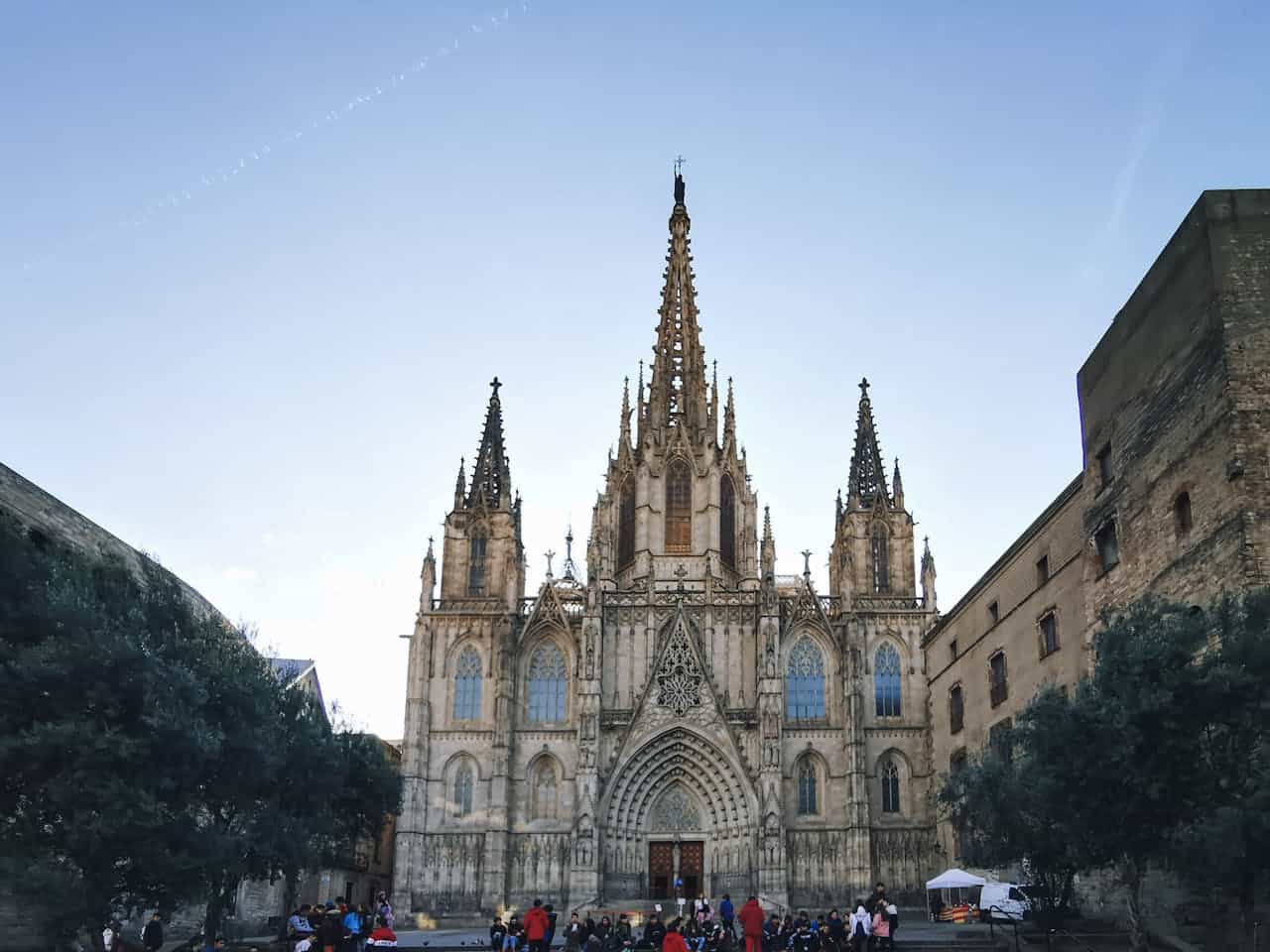
Santa Eulalia´s Cathedral
The Cathedral of the Holy Cross and Saint Eulalia is the heart of the neighbourhood. Although its Neo-Gothic façade is somewhat misleading, its interior is pure 13th- to 15th-century Catalan Gothic
- Thirteen white geese live in the inner garden. This is no coincidence: they represent the 13 tortures suffered by Saint Eulalia, the city’s patron saint, before she was executed by the Romans at the age of 13.
- Beneath the high altar lie the saint’s remains in a polychrome alabaster sarcophagus, a masterpiece of sculpture.
- You can visit the cathedral after closing time to enjoy exceptional views; with limited capacity, access the terrace and enjoy exceptional views of Barcelona for around €28. From there, the dome and the views of the neighbourhood’s rooftops offer a perspective that looks as though it has been taken from a medieval illustration.
The mystery of the Pont del Bisbe
It is probably the most photographed street in Barcelona. Although it looks medieval, this neo-Gothic bridge was built in 1928. Take a look at the skull and dagger adorning its underside; local legends say that if the dagger is removed, Barcelona will sink, but if you cross the bridge with your back to the skull, a wish will be granted.
A living legend has it that if anyone walks under the bridge and makes a wish by touching the skull and dagger, their wish will come true. Whether or not this is true, there is no doubt that it adds an element of intrigue to this already fascinating structure, making a visit here a must-see on your tour of the Gothic Quarter.
The Forgotten Jewish Quarter
To the south-west of Plaça de Sant Jaume lies El Call, the old Jewish quarter. It is a maze of streets so narrow that barely one person can pass through at a time.
- The Great Synagogue: It is one of the oldest in Europe. It was rediscovered relatively recently and can now be visited to gain an understanding of the importance of Jewish culture in 14th-century Barcelona.
- Sant Jaume Street: Here you will find Hebrew inscriptions on the stones of the buildings, reused from ancient tombstones following the expulsion of 1492.
Have you heard of the ‘Fake Gothic’?
It is important to distinguish between what is historical and what is “aesthetic”. The Gothic Quarter owes its name to an image campaign in the early 20th century led by Adolfo Florensa.
- The Pont del Bisbe: Designed by Joan Rubió i Bellver in 1928. Despite being “new”, its skull pierced by a dagger is the neighbourhood’s most mystical symbol. They say that if you stare at the skull whilst crossing with your back to it, a wish will be granted.
- Casa Martí (Els Quatre Gats): This neo-Gothic building by Puig i Cadafalch is located on Carrer Montsió. It was the epicentre of Modernism; it was here that a young Picasso held his first exhibition and the artists of the time would debate until the early hours of the morning.
The best places to eat in the Gothic Quarter
- Bar La Plata: A classic on Carrer de la Mercè. They only serve four tapas (fried fish, anchovies, butifarra sausage and salad), but their quality has been legendary since 1945, which means they’re always busy.
- La Alcoba Azul: Located in the Jewish quarter. It is a dark, magical spot, perfect for sampling its famous tostas and platters of Catalan cured meats in an intimate setting.
- Els Quatre Gats: Living history. This neo-Gothic building was once a gathering place for the Modernist bohemian crowd (Picasso, Gaudí). It is the ideal spot to enjoy traditional cannelloni or cod in an unrivalled artistic setting.
- Viana: Near Plaza Real. It offers creative market-fresh cuisine with impeccable presentation. It is small and cosy, so booking is essential.
- Restaurante Colom: If you’re looking for rice dishes or paellas offering good value for money right in the city centre, this traditional-style restaurant is an excellent choice.
If you’re looking for a spot to enjoy a sweet treat, we recommend a stroll down Calle Petritxol: known as ‘Chocolate Street’. Shops such as La Pallaresa or Dulcinea are must-visit spots for a ‘suizo’ with churros. Another great alternative is La Colmena: a patisserie dating back to 1849 in Plaza del Ángel. Don’t leave without trying their handmade sweets or their cream-filled xuxos.
Tips to ensure you don’t miss a thing
- The Kiss Mural: In Plaça d’Isidre Nonell, look out for the photo mosaic “The world is born in every kiss”. It is made up of thousands of tiles featuring photos of locals depicting “moments of freedom”.
- Avoid tourist traps: On La Rambla, prices are sky-high and quality is poor. Walk two streets into the Gothic Quarter and you’ll find excellent set menus for around €15.
- The Modernist Postbox: At the Casa de l’Ardiaca (next to the Cathedral), look for the postbox designed by Domènech i Montaner featuring swallows (freedom of justice) and a tortoise (the slowness of bureaucracy).
- Safety: The neighbourhood is safe, but its streets are a pickpocket’s paradise for the unwary. Always keep your bags in front of you and be extra vigilant in Plaza Real.
- Comfortable footwear: Forget heels or thin soles. The cobblestones of the Gothic Quarter are relentless on your feet if you don’t have proper support.
- Look up: Much of the Gothic Quarter’s beauty lies in the gargoyles, the busts on the façades and the wrought-iron details on the balconies.
- Cathedral opening times: If you want to visit for free, check the service times; but remember that the full tour (museum and rooftops) always requires a ticket.
Don’t miss out on one of Barcelona’s most special neighbourhood
Visiting the Gothic Quarter isn’t just about ticking off monuments on a map; it’s about treating yourself to the luxury of putting your phone away and wandering aimlessly. It’s about discovering a century-old hat shop on one corner and a street musician playing the cello in front of a Roman wall on the next.
Barcelona was born in these streets, and that age-old energy can be felt in every shaded corner.
Don’t be in a hurry to reach the next tourist stop; the true treasure of the Gothic Quarter is that moment when, after turning any corner, the noise of the modern city fades away and all that remains is you, the silence of the stone and the weight of twenty centuries of civilisation.
Enjoy the stroll, let your footsteps set the pace, and discover why this corner of Barcelona continues to captivate anyone who dares to lose themselves in it.