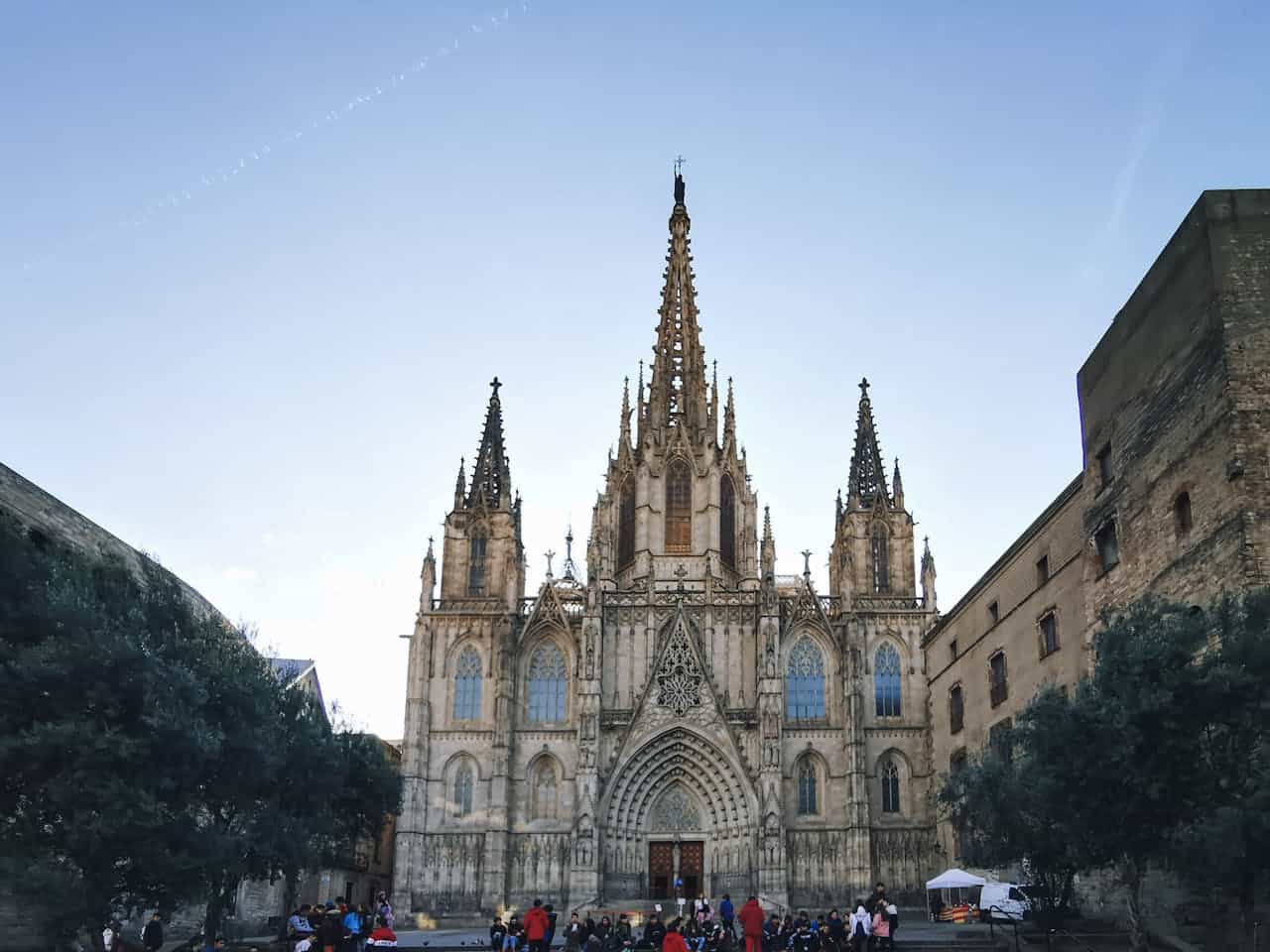
If there is one name that has gone hand in hand with Barcelona over the years, it is Antoni Gaudí.
His works do not go unnoticed; they are buildings that breathe, surprise and challenge everything we thought we knew about architecture. If you have a day in the city and want to truly understand why Barcelona is unique, the Gaudí route is undoubtedly an essential experience.
At Lock Here Now, we have written this post going beyond the typical ‘must-sees’ that you find everywhere. It´s the itinerary that we ourselves follow, with the best local tips, the corners that almost no one knows about, and tricks that only someone who lives in the city can give you.
Why is Gaudí still the main reason to visit Barcelona?
More than 130 years after Antoni Gaudí began transforming Barcelona, long queues stretching around entire blocks gather around his buildings. It is not nostalgia; it is because the architect designed buildings that were decades ahead of their time and which, seen today, still seem to have been taken from the future.
Seven of his works are part of UNESCO’s World Heritage. No other architect in history has such a distinction. Park Güell, Palau Güell, Casa Milà, Casa Vicens, the Crypt of Colònia Güell, Casa Batlló and, of course, the Sagrada Família: each one is a universe unto itself.
But visiting Gaudí’s works is not simply a matter of ticking boxes on a list. The key is to understand the common thread that links all his works: nature as a source of absolute inspiration, the rejection of straight lines, the revolutionary use of colour, light and organic forms.
How to plan your Gaudí route?
Book your tickets online in advance; this is non-negotiable. The Sagrada Familia, Park Güell and Casa Batlló are three of the most visited monuments in Europe. Trying to enter without a prior reservation, especially in high season, means facing queues of between 2 and 4 hours, or simply not being able to get in.
Our local tip: book all tickets at least 3-4 weeks in advance if you are travelling in high season, and at least 1 week in advance in low season. Tickets are sold on the official websites of each monument and, once they are sold out, there is no solution.
Where do we should start?
Lots of travelers make the mistake of starting with the places closest to their hotel, without thinking about how far they are or how long it’ll take to get there. The route we suggest is designed to make the most of your time, minimise travel and take advantage of the best light at each spot.
The order of the tour is not randomly chosen: it starts at 9:00 am at Park Güell to take advantage of the morning light and smaller crowds, and ends at Casa Batlló at sunset, when the setting sun makes the ceramic façade shine in a way that is unmatched at any other time of day.
We start at Park Güell (Gràcia hills), go down to Eixample for the Sagrada Família and Casa Milà, and finish in Passeig de Gràcia with Casa Batlló.
Before setting off on your journey, there is one practical detail that makes a big difference: what do you do with your suitcase? If you arrive in Barcelona on the same day you are going to visit Gaudí, or if you check out in the morning and your return flight does not leave until the evening, lugging your luggage around Park Güell or Passeig de Gràcia becomes an unnecessary torture.
At Lock Here Now, we have a luggage storage in Barcelona to take care of your bags so you can focus on enjoying the city and pick it up when it suits you, without worrying.
Our Route through Gaudí’s most emblematic work
09:00 h · Park Güell
Start your day in a big way. Park Güell, a UNESCO World Heritage Site since 1984, was originally designed as a luxury housing development that was never completed. What remained was something much better: a park with mosaic stairways, a terrace with the most photographed multicoloured ceramic bench on Instagram, the sloping columns of the Hypostyle Hall and panoramic views over the entire city.
The monumental zone (the area that requires an entrance ticket) is the most visited, but the park as a whole is immense. Spend at least an hour and a half in the paid area, and if you have the energy and time, exploring the park will allow you to discover viaducts and bridges with unique views that almost no one visits.
If you are an early bird, we recommend heading straight to the main terrace at sunrise (arriving before 9:30 am means there are far fewer people). The Casa del Guarda, renovated as an exhibition space, and finally, if you go to the highest point of the park, the Turó de les Tres Creus, you will get the best panoramic view of Barcelona.
If you’re wondering how to get to Park Güell, we recommend going in through Carrer Olot to the monumental area. To avoid the climb on foot, take the H6 or 116 bus from Travessera de Dalt. You can check the timetables live on the official website. A taxi to the door costs around €8-10 from the Eixample and saves you a 15-minute climb.
11:00 h ·A great forgotten jewel of Gràcia
Just a 10-minute walk from Park Güell, in the Gràcia neighbourhood, lies one of Gaudí’s most surprising and least visited works: Casa Vicens. Built between 1883 and 1885, it was the architect’s first major work and already heralded all the obsessions that would define him: Moorish latticework, hand-painted tiles, green ceramic-covered domes, wrought iron finials.
Added to the UNESCO list in 2005, it is nevertheless the least known of his great works. Queues are practically non-existent and the visit is intimate and peaceful.
One interesting fact is that, as Casa Vicens was full of Helichrysum stoechas plants, Gaudí incorporated them directly into the design of the wrought iron railings in the garden. This is a perfect example of his philosophy: nature as the supreme architect.
12:30 h · Sagrada Familia
There is no building under construction in the world that generates more fascination than the Sagrada Familia. Gaudí devoted the last 43 years of his life to this project—which is still under construction more than 140 years after it began—and he rests here in the crypt. Visiting it is not just seeing a church: it is witnessing the greatest act of architectural faith in modern history.
From the inside, the effect is supernatural. The pillars branch out like trees, light filters through the stained-glass windows, transforming the interior into a luminous forest, and you feel as if you are inside something alive and in perpetual transformation. Although the exterior is impressive, it is the interior that truly changes people.
Spend at least two hours on your visit. If you have the time and budget, add access to the towers: the lift takes you up to a height of 65 metres with extraordinary views of the Eixample district and the sea. The Nativity towers (east façade) offer better views of the park; the Passion towers (west façade) overlook the neighbourhood.
The Sagrada Família has two entrances: one on the Nativity façade (Avinguda de Gaudí) and one on the Passion façade (Carrer de Sardenya). Check which entrance you should use according to your booking. Arriving at the wrong entrance could mean you miss your entry time.
15:00 h · Enjoy the Eixample at your own pace
Just a stone’s throw from the Sagrada Família, Avinguda de Gaudí and the Temple area are popular tourist spots: the restaurants in the area are functional, but rarely memorable. We recommend walking about 10 minutes into the Eixample district and looking for any of the local markets or typical restaurants in the neighbourhood.
If you want to make the most of your time, the Mercat de l’Abaceria (in Gràcia) or the bars on Carrer Enric Granados—a beautiful pedestrian street in the heart of the Eixample—are much more authentic and economical options than the tourist traps around the monuments.
Enric Granados Street, nicknamed the ‘Champs-Élysées of Barcelona’, is the perfect place to take a break after your morning walk. You can relax on terraces, in the shade of trees, and in restaurants with daily menus for €12-15.
16:30 h · Casa Milà (La Pedrera)
After lunch, Passeig de Gràcia awaits you. Casa Milà, popularly known as La Pedrera (‘the quarry’, due to its sculpted rock appearance), was Gaudí’s last civil engineering work, built between 1906 and 1912. It is perhaps his most radical architectural gesture: an undulating façade without any right angles, terraces inhabited by stone warriors, a floor plan that is reorganised without load-bearing pillars.
The visit includes the interior of the building—a restored flat with period furniture that shows how the Barcelona bourgeoisie lived in the early 20th century—and, above all, the roof terrace, a world unto itself with the famous chimneys shaped like warriors and spirals that Gaudí designed as if they were sculptures. Its roof terrace is one of the best viewpoints in the Eixample district.
If you visit Barcelona between June and September, you can enjoy ‘La Pedrera de Nit’, night-time concerts on the rooftop under the stars. It is more expensive than standard admission, but absolutely unique. However, you must book months in advance.
Sunset at Casa Batlló
Finishing off the route, just 200 metres from La Pedrera on Passeig de Gràcia, Casa Batlló is Gaudí’s most dazzling building. Renovated in 1904, the façade depicts the legend of Saint George slaying the dragon: the balconies are the bones of the dragon’s victims, the roof is its scaly back of blue and green ceramic, and the tower at the top is the hero’s spear.
Completely modernized with immersive technology and augmented reality, the interior tour takes visitors through the main rooms, the dragon’s belly—an interior atrium with blue tiles that change colour depending on the height to simulate the seabed—and the rear terrace. It is the most avant-garde and emotionally impactful Gaudí experience in the city.
The iridescent ceramic façade of Casa Batlló comes to life in the light of the setting sun. The blues, greens and golds sparkle in a way that is not possible at any other time of day. If you can choose your entry time, we recommend between 6pm and 7.30pm.
The complete route we have described can be done in one long summer day. On short winter days, we recommend skipping Casa Vicens or La Pedrera, or doing the route over two days if possible so you don’t have to rush and can enjoy each place.
If you only have half a day, choose between the North combination (Park Güell + Sagrada Família) or the South combination (La Pedrera + Casa Batlló). Both are complete experiences in themselves.
Common FAQ´S about Gaudi Work Route
Are there any passes or discounts for visiting several of Gaudí's works?
There is no single pass for all of Gaudí’s works, as each one is managed by a different entity. Some monuments offer discounts for young people, students, seniors over 65, or families. The Barcelona Card does not include Gaudí’s major works. We recommend purchasing each ticket directly from the official websites to avoid extra costs and problems with resellers.
How much it costs?
Prices vary depending on the type of visit (basic, with towers, with audio guide, night experiences), the time of year and whether you book in advance or at the ticket office (there is usually a 10-15% surcharge at the ticket office if there is availability).
- Sagrada Família (basic ticket): from €26.
- Park Güell (monumental area): €10.
- Casa Batlló (basic admission): from €35.
- Casa Milà / La Pedrera: from €25.
- Casa Vicens: from €16.
- Palau Güell: €12.