Holy Week in southern Spain is a feast for the senses: the air is filled with a blend of scents, the silence is broken only by the plaintive notes of a saeta or the roll of a drum, and the streets become a museum of living art.
During these days, Andalusian cities beat to a different rhythm. And although each province has its own unique character, today we want to immerse ourselves in those where the Passion is experienced in a truly magical way: Seville, Granada and Córdoba.
The art of ‘La Madrugá’ in Seville
To speak of Seville’s Holy Week is to speak of one of the most famous celebrations in the world. Here, the people’s enthusiasm knows no social boundaries; the entire city takes to the streets from Palm Sunday to Easter Sunday to accompany the nearly sixty brotherhoods as they make their penitential procession.
The highlight comes on the night between Maundy Thursday and Good Friday with the famous ‘Madrugá’. It is a night of raw emotion, where revered images such as La Macarena, Cristo del Gran Poder and La Esperanza de Triana make their way through the city until dawn. Watching a float sway in the dim light of the candles, whilst someone begins to sing a saeta from a balcony, is a spine-tingling experience.
How to make the most of Holy Week in Seville
The crowds that gather in areas such as Plaza de la Campana or Calle Sierpes are immense. Trying to navigate the packed city centre during the processions, dragging a suitcase before check-in or on the day of your return, is, quite frankly, an impossible (and frustrating) task. To really experience the festivities, we recommend using the Lock Here Now locker service in Seville. Leave your luggage safely stored and head out to wander the streets, follow the brotherhoods and soak up the atmosphere with your hands completely free.
Passion amidst hills, caves and fire in Granada
If you’re looking for a Holy Week celebration set against an unrivalled backdrop, Granada is the place for you. Declared an Event of International Tourist Interest, the processions here have the privilege of passing at the foot of the Alhambra, creating scenes of breathtaking beauty.
One of the most spectacular and unique moments in the world takes place on the night of Holy Wednesday in the Sacromonte district. As the float of Cristo de los Gitanos ascends the hills, huge bonfires are lit beside the famous cave houses. There, prayer transforms into pure flamenco through the gypsy zambras. On Holy Thursday, the spotlight shifts to the historic Albaicín district, where a respectful silence envelops processions such as that of the Cristo del Silencio. And we mustn’t forget ‘Las Chías’ on Good Friday, a curious group of characters with fanfares and kettledrums who lead the Soledad de San Jerónimo brotherhood.
The trick to getting around Granada
Anyone who has visited Granada knows that the Albaicín and Sacromonte are beautiful, but they are full of steep slopes and cobbled streets. Climbing up to see the gypsies’ bonfires while carrying heavy loads is exhausting. The smartest thing to do is to pop into one of our locker facilities in Granada, leave your rucksacks or bags behind, and tackle Granada’s hills light on your feet to enjoy that magical night without straining your back.
Holy Week in Córdoba
Holy Week in Córdoba has a different rhythm, one that is far more intimate. Here, anticipation blends with a deep sense of reverence. The setting could not be better: the floats pass through the arches of the Mosque-Cathedral and wind their way through the narrow, whitewashed streets of the Jewish Quarter.
What makes the greatest impression in Córdoba are the sounds and the silences. The tinkling of the foreman’s bell, the sharp clang of the knocker, the cry of “Up with it!” and the indescribable effort of the bearers, who often have to get down on their knees to manage to get the floats through the church doors. It is a Holy Week to experience up close, breathing in the scent of burning wax and soaking up the city’s historic atmosphere.
Your best ally in the Jewish Quarter
The streets of Córdoba are so narrow that, when a brotherhood passes through, there’s literally no room to swing a cat. If your train leaves late and you’ve already checked out of your accommodation, don’t even think about heading into the historic centre with your suitcase; you could get stuck between the crowd and the procession.
Use a locker facility where your belongings will be safe, leaving you free to focus solely on finding that perfect spot to watch the brotherhoods pass by in silence and in complete comfort.
Interesting facts you (perhaps) didn’t know about Holy Week
To help you better understand what you’re seeing in the streets, here are some fascinating facts that will help you grasp the significance of this tradition:
- Why do they wear hoods? That pointed hood and the cloth covering the Nazarenos’ faces have their origins in penance. It was designed this way to ensure total anonymity; the idea is that penance is an intimate matter between the believer and God, so no one should know who is hiding beneath the robe.
- Mantles made of flowers: Although it is common to see rich embroidery in gold thread, some brotherhoods, such as the Virgen de las Penas in Málaga, weave a spectacular mantle every year made entirely from fresh flowers.
- The figure of the Costalero: These are the people who carry the ‘paso’ (the wooden structure bearing the figures) on their backs and necks (‘a costal’). A paso can weigh over 2,000 kilos! They are guided solely by the foreman’s voice, as they are in complete darkness beneath the structure.
- How is the date of Holy Week decided? It is not a whim of the calendar, but pure astronomy. As agreed at the historic Council of Nicaea, Easter Sunday must be the first Sunday following the first full moon of spring. That is why the date can vary by up to a month from one year to the next!
- One of the most heart-warming and characteristic sights in Andalusia is seeing children running behind the penitents. Their aim is to collect the drops of hot wax falling from the candles, forming ever-larger coloured balls as the days go by.
- The forgiven in Málaga: Although we have focused on three cities, Málaga has a unique tradition: every year, by virtue of a historical privilege granted by King Charles III in the 18th century, the procession of the brotherhood of Jesús El Rico releases a royal prisoner.
Tips for your visit beyond the processions
If you’re visiting Andalusia at this time of year, your trip doesn’t have to be 100% religious. Here are a few recommendations to round off the experience:
What to eat? (Lent cuisine)
During this period, tradition dictates that meat should be avoided, which has given rise to some exquisite cuisine. You must try Potaje de Vigilia (chickpeas, spinach and cod), cod fritters and, of course, the crowning glory of the pastries: Torrijas (bread soaked in milk or wine, fried and sweetened with honey or sugar) and pestiños.
‘Survival’ tips for eating out during Holy Week
Eating out in the city centre during this period can be a logistical challenge. If you want to avoid frustration and endless waits, follow these tips:
- We’d recommend eating early at 13:00 or having a late dinner. If you try to eat at peak times, it’ll be almost impossible to find a seat.
- The 15-minute rule for discovering the authentic: At lunchtime, venture a little further afield and you’ll find bars with space, better prices and more authentic food.
- Standing tapas: The most practical option these days is to seek out the best tapas, eating quickly at the bar or at high tables; you’ll even find that many establishments remove the chairs to speed up service.
- Always carry water and a light snack in your rucksack. Sometimes a procession can leave you ‘stuck’ in a street for an hour or more.
Where to stay during Holy Week?
The golden rule is: book well in advance (sometimes a year in advance).
- If you want to be right in the thick of things, look for accommodation in the historic centres, but be prepared for the sound of drums at all hours.
- If you prefer a quieter stay, look for outlying neighbourhoods with good transport links. In Seville, the Triana or Nervión areas; in Granada, the Ronda or Zaidín neighbourhoods; and in Córdoba, the modern Vial Norte area.
What else is there to do at this time of year?
The weather in spring is usually spectacular.
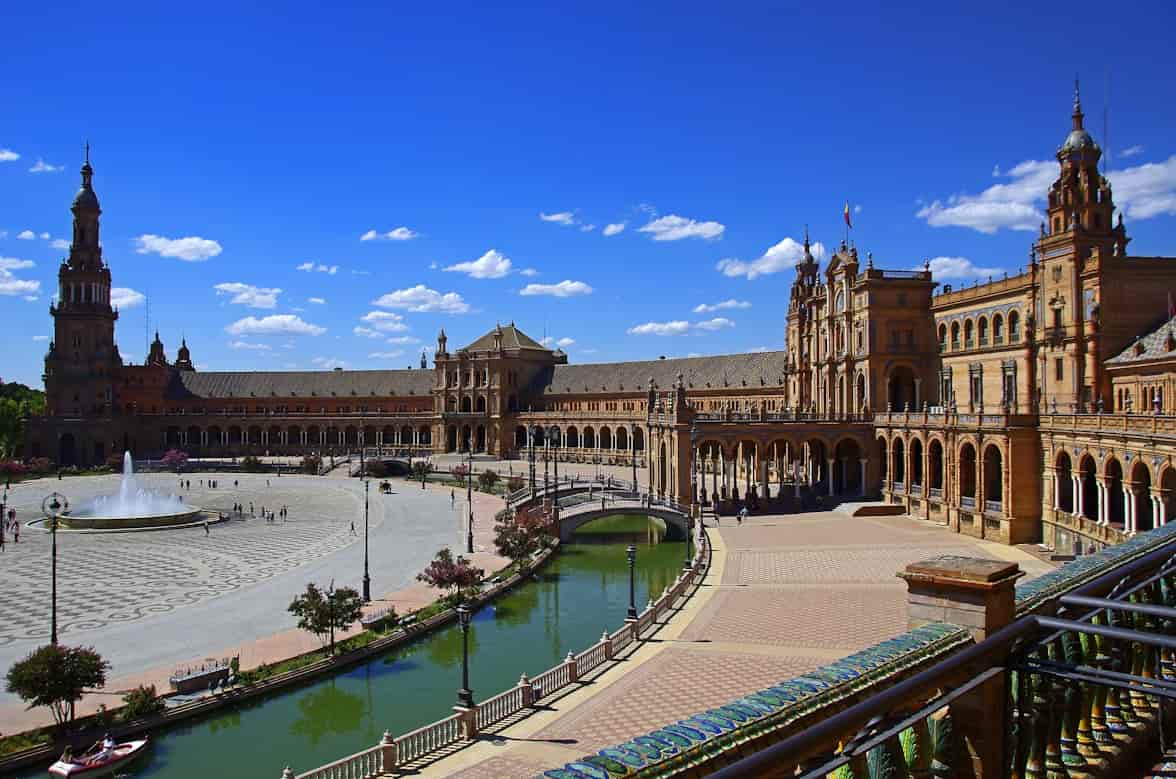
- In Seville: Take a stroll through María Luisa Park, visit the Real Alcázar or head to the River Guadalquivir at sunset.
- In Granada: Head up to the Mirador de San Nicolás at sunset (when there are no processions in the area) or, of course, book your ticket in advance to lose yourself in the Generalife gardens at the Alhambra.
- In Córdoba: Although the official festival is in May, many of the famous Patios of Córdoba already look spectacular, filled with pots and flowers during Holy Week. Head to the Alcázar Viejo neighbourhood to have a look around.
Much more than a tradition, a memory to last a lifetime
Holy Week in Andalusia cannot be explained; it has to be experienced. It is the scent of orange blossom in a street in Seville, the deathly silence of a neighbourhood in Córdoba, or the flames illuminating the caves of Granada beneath the gaze of the Alhambra. It is, in short, a journey to the heart of a people who transform their history and faith into the most impressive artistic display in the world. If you decide to visit at this time of year, let yourself be carried along by the flow of the crowd, pause at the sound of a saeta, and treasure in your memory the glow of the candles beneath the moon. Andalusia awaits you to offer you a unique experience.